Showing posts with label India. Show all posts

Monday, March 26, 2012


Tibetan sets himself ablaze in India before Chinese leader visits
March 26, 2012 | 7:29am
Mark Magnier


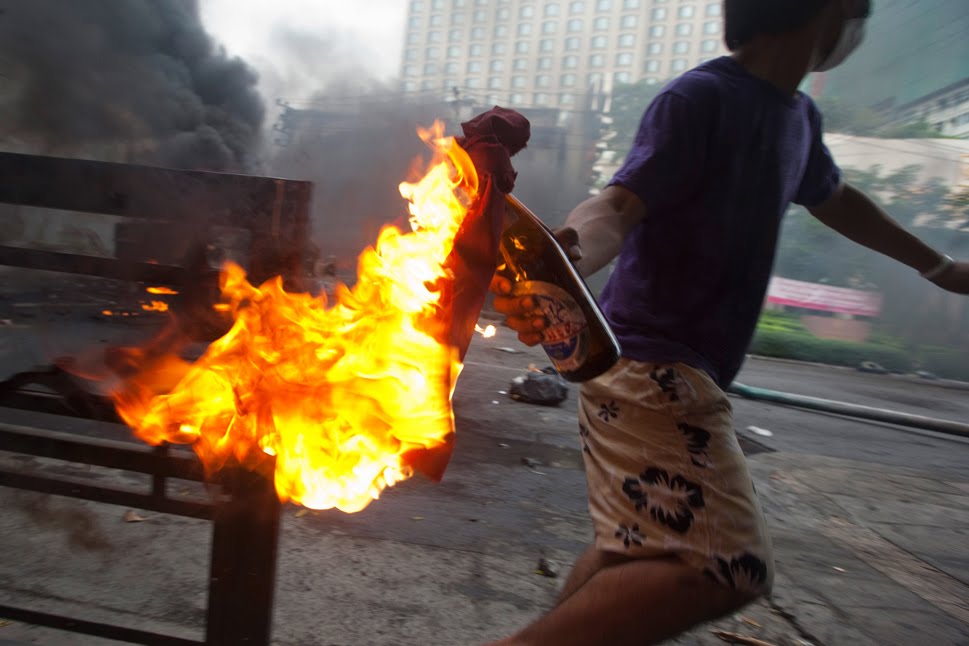
REPORTING FROM NEW DELHI -- A Tibetan set himself on fire Monday before running several hundred feet down a busy New Delhi street, suffering critical burns in advance of a visit by Chinese President Hu Jintao.

The protester, identified by Tibetan activists as Janphel Yeshi, 27, attempted the self-immolation at Jantar Mantar, an open area where rallies and demonstrations are often held. Media reports, citing witnesses, said Yeshi yelled as he ran along the road dressed in a sweater and dark trousers, black smoke pouring from his hair.

“Basically he was on fire for almost 10 minutes before the police arrived,” said Rinzin Choedon, a chapter coordinator with Students for a Free Tibet, an activist group. “Personally, I’m totally against this sort of immolation. Our struggle is not just for today or tomorrow. If we lose our human power and resources, how can we continue the struggle?”

Tibet has been a vassal state of China for much of its history. In 1950, the Chinese military took control, leading to the exile in 1959 of the Dalai Lama, the Tibetan spiritual leader.

Many Tibetans in China bridle at Chinese rule, arguing that their religion, culture and traditions are being systematically smothered by Beijing under policies aimed at relocating large numbers of Han Chinese to the plateau.

This is the second attempted self-immolation in New Delhi, which is home to thousands of Tibetans who have crossed over the Himalayan mountains from China. In November, a man suffered minor burns when he tried to set himself alight outside the heavily guarded, barbed-wire ringed Chinese Embassy before police doused the flames.

“This is very unfortunate,” said Tempa Tsering, the Dalai Lama’s representative in New Delhi. “It’s because of the policies of the repressive [Chinese] government.”

Hu is scheduled to arrive in the Indian capital Wednesday to attend a summit on the so-called BRICS nations of Brazil, Russia, India, China and South Africa.
Since the beginning of 2011, more than two dozen Tibetans, including many Buddhist monks and nuns, have reportedly set themselves ablaze in the Tibetan area of China to protest Beijing’s rule.

Some activists described Yeshi as unemployed, a resident of the main Tibetan exiles' neighborhood in Delhi who fled China in 2005. Others said he did odd jobs at a small monastery. He reportedly had been planning the protest for days, arriving at Jantar Mantar with a bottle of kerosene he poured over himself.

The Associated Press reported that he ran about 160 feet in flames before collapsing. At the time, dozens of people were attending a Tibetan protest rally nearby. Dr T.S. Sidhu, medical supervisor at Delhi’s Ram Manohar Lohia hospital where he was taken, said Yeshi is in critical condition with burns on 90% of his body.

China often blames India for fomenting unrest in Tibet. India’s mountainous northern town of Dharamsala is home to the Dalai Lama and the Tibetan government in exile.

“China can’t even blame India for this, though,” said Mohan Guruswamy, a China expert with New Delhi’s Center for Policy Alternatives, a think tank. “There’ve been some 28 immolations in China. India urges China to talk to the Tibetans. They’re so unhappy, you have to at least talk.”

Opinions differ over how effective the drastic tactic of self-immolation is. Guruswamy said as gruesome as it is, the tactic draws attention to the Tibetan plight in the same way the self-immolation of monks during the Vietnam War helped turn public opinion worldwide against the conflict.

Others disagreed.

“I’m not sure it’s going to galvanize public opinion,” said Rukmani Gupta, an associate fellow at Delhi’s Institute for Defense Studies and Analyses, a think tank. “What you have is young people losing their lives. That’s not necessarily any gain toward talks between Beijing and Dharamsala.”

Monday, February 7, 2011


Surge of immigrants from India baffles border officials in Texas
Thousands from India have entered Texas illegally from Mexico in the last year. Most are Sikhs who claim religious persecution at home.
--latimes.com--
February 06, 2011|By Richard Marosi and Andrew Becker

Reporting from Harlingen, Texas — Thousands of immigrants from India have crossed into the United States illegally at the southern tip of Texas in the last year, part of a mysterious and rapidly growing human-smuggling pipeline that is backing up court dockets, filling detention centers and triggering investigations.

The immigrants, mostly young men from poor villages, say they are fleeing religious and political persecution. More than 1,600 Indians have been caught since the influx began here early last year, while an undetermined number, perhaps thousands, are believed to have sneaked through undetected, according to U.S. border authorities.


Hundreds have been released on their own recognizance or after posting bond. They catch buses or go to local Indian-run motels before flying north for the final leg of their months-long journeys.

"It was long … dangerous, very dangerous," said one young man wearing a turban outside the bus station in the Rio Grande Valley town of Harlingen.

The Indian migration in some ways mirrors the journeys of previous waves of immigrants from far-flung places, such as China and Brazil, who have illegally crossed the U.S. border here. But the suddenness and still-undetermined cause of the Indian migration baffles many border authorities and judges.

The trend has caught the attention of anti-terrorism officials because of the pipeline's efficiency in delivering to America's doorstep large numbers of people from a troubled region. Authorities interview the immigrants, most of whom arrive with no documents, to ensure that people from neighboring Pakistan or Middle Eastern countries are not slipping through.

There is no evidence that terrorists are using the smuggling pipeline, FBI and Department of Homeland Security officials said.

The influx shows signs of accelerating: About 650 Indians were arrested in southern Texas in the last three months of 2010 alone. Indians are now the largest group of immigrants other than Latin Americans being caught at the Southwest border.

The migration is the "most significant" human-smuggling trend being tracked by U.S. authorities, said Kumar Kibble, deputy director of Immigration and Customs Enforcement, or ICE. In 2009, the Border Patrol arrested only 99 Indians along the entire Southwest border.

"It's a dramatic increase," Kibble said. "We do want to monitor these pipelines and shut them down because it is a vulnerability. They could either knowingly or unknowingly smuggle people into the U.S. that pose a national security threat."

Most of the immigrants say they are from the Punjab or Gujarat states. They are largely Sikhs who say they face religious persecution, or members of the Bharatiya Janata Party who say they are targeted for beatings by members of the National Congress Party.

But analysts and human rights monitors say political conditions in India don't explain the migration. There is no evidence of the kind of persecution that would prompt a mass exodus, they say, and Sikhs haven't been targets since the 1980s. The prime minister of India, Manmohan Singh, is a Sikh.

"There is no reason to believe these claims have any truth to them," said Sumit Ganguly, a political science professor and director of the India Studies Program at Indiana University.

Some authorities think the immigrants are simply seeking economic opportunities and are willing to pay $12,000 to $20,000 to groups that smuggle them to staging grounds in northern Mexico. Kibble said smugglers may have shifted to the Southwest after ICE dismantled visa fraud rings that brought Indians to the Northeast.

Many Indians begin their journey by flying from Mumbai to Dubai, then to South American countries such as Ecuador or Venezuela, according to authorities and immigration attorneys. Guatemala has emerged as the key transit hub into Mexico, they said. The roundabout journeys are necessary because Mexico requires visas for Indians.

They sneak across the dangerous Guatemala-Mexico border and take buses or private vehicles to the closest U.S.-Mexico border. Mexican organized crime groups are suspected of being involved either in running the operations or in charging groups tolls to pass through their territory.

The Indians usually wade across the Rio Grande, and then are shuttled from stash houses to transportation rings that take them north. David Aguilar, deputy commissioner of Customs and Border Protection, an agency within the Department of Homeland Security, said he believed a high percentage were caught as soon as they crossed the river.

"We very intensely interview, look at their backgrounds, check them against any watch list," Aguilar said, adding that although India is not considered a "special interest" source country for terrorists, the undocumented immigrants are scrutinized as if it were.

The detainees eventually claim asylum. In January, immigration court calendars at the area's two main detention facilities were full of the common Indian surnames Patel and Singh, and attorneys and judges struggled to keep up. Some attorneys had failed to file the necessary forms; interpreters were not always available. Judge Keith Hunsucker said more immigration judges would soon be assigned to handle the increased workload.

Many detained immigrants clear the first hurdle toward a full asylum hearing by convincing asylum officers they have a "credible fear" of persecution if they return to India. They can then post a bond and move anywhere in the United States as long as they agree to appear for their next court date.

Not all show up, however. "That's why I won't take their cases anymore," said Cathy Potter, a local immigration attorney who helped about 20 Indians get freed on bond last year. "It undermines my credibility. I don't want anything to do with this."

It is not clear how many Indians have been granted asylum or deported; immigration officials did not fulfill requests for that information. Judges and attorneys appear to be toughening up, however. Bond amounts have risen sharply in recent months, and attorneys say asylum claims are increasingly being rejected.

Judge William Peterson raised doubts during a recent hearing when a 27-year-old Punjabi woman said she had been beaten and raped, her sari ripped off by several attackers. The petite woman, her long hair in a ponytail, said she was targeted because her husband was a driver for National Congress Party officials.

"I haven't heard you tell me anything that you did on behalf of the party that would irritate these people," Peterson said at the hearing held by video conference.

"We used to give help to the poor. They did not like that," she said. Peterson rejected her claim for a finding of "credible fear," deeming her story inconsistent with statements she had made to an asylum officer. "They're going to kill me. They're going to rape me," she pleaded, wiping away a tear.

But hundreds of immigrants have persuaded asylum officers and judges to grant credible-fear findings, clearing the way for bond hearings.

Hunsucker, an immigration judge at the Port Isabel Detention Center near Brownsville, set bond amounts ranging from $15,000 to $40,000 for 10 Indians one recent morning.

Most said they had relatives or friends in the U.S. willing to sponsor them, though the judge raised concerns about some. In one case, a young man said his sponsor was his cousin, a woman. But the faxed identification document of the cousin showed a picture of a man with a beard. The bond was set at $15,000.

Once released, the immigrants are transported to the Greyhound bus station in downtown Harlingen. One recent evening, 10 Indians crowded around pay telephones and the bus counter, struggling with limited English skills to arrange travel.

One young man paid for a $204, two-day bus ride to New York City. When the clerk asked his name, he handed over his detention center ID wristband.

A young man wearing a turban asked the clerk for information on the next bus to Indiana. He spoke broken English and later tried to provide details about his journey, but other immigrants nudged him to keep quiet. The trip was worth it, he said, adding, "I'm happy, because it's safe" in the U.S.

Outside, motel operators offered to shuttle the men to their nearby quarters. Shoving matches between motel operators have broken out in recent weeks as they compete to fill their $44-per-night rooms with immigrants.

The Indians are largely unseen in the towns along the Rio Grande Valley, where they disappear into detention centers, stash houses or motel rooms. Some Sikhs have been confronted by locals alarmed by the sight of people wearing turbans, motel workers say.

Federal agents investigating human-smuggling rings have visited at least one motel, America's Best Value Inn in Raymondville, workers said. General Manager Kevin Patel denied any wrongdoing.

He houses about 20 Indians per week, he said, shuttling them to and from the bus station and printing out airline boarding passes. He serves them meals in his motel apartment, often the first Indian food they've had in months, he said.

One recent guest, Bharat Panchal, 37, said he was released from detention in late January after friends posted his $20,000 bond. India had become dangerous, he said, because of political unrest in his home state of Gujarat. He was flying later that day to Los Angeles to live with a friend, he said.

Patel said the sudden appearance of Indian immigrants in southern Texas baffled him.

"When they first showed up, I scratched my head a little bit," Patel said. But he has opened his doors and makes the immigrants feel at home.

"They need a place to stay," he said. "They need food. They speak my language, so of course, as a human being, I can help them out."

richard.marosi@latimes.com

abecker@cironline.org

This report is published in cooperation with the nonprofit Center for Investigative Reporting in Berkeley, where Becker is a staff reporter.

Saturday, August 14, 2010


Countries Not In Favor of Kosovo Sovreignity and Thier Rational
(69 countries, including the United States and 22 of the EU’s 27 members, have recognised Kosovo....)
-Courtesy of The Economist-
7/29/10


on Orthodox Christian Solidarity
-Russia
-Romania
-Cyprus
-Greece

on Domestic Seccessionist Issues
-Russia
-China
-India
-Romania
-Slovakia
-Cyprus
-Spain

on Non-Aligned Nostalgia
-India
-Brazil
-Egypt
-Cuba
-India

on Geopolitical Concerns
-Russia
-China
-Brazil
-Greece
-Cuba

on Territorial Integrity True Believers
-China
-Brazil
-Romania
-Slovakia
-Cyprus
-Greece
-Spain
-Egypt
-Cuba
-India

Monday, May 17, 2010


India's Failing Counterinsurgency Campaign
BY ANUJ CHOPRA | MAY 14, 2010
--ForeignPolicy.com--


The Maoists got their start in 1967 as a peasant revolution against rich, exploitative landlords, and the movement has germinated in rural areas stalked by poverty, misery, and disease ever since. In 2004, when the rebels were present in nine states, India's Home Ministry put the movement at an estimated 9,300 hard-core underground members. Since then, they have spread into 22 of India's 35 states and territories, and their numbers have increased by several thousand, prompting the Indian government to declare them the country's biggest internal enemy. Currently, some estimate that the movement is made up of 40,000 permanent members and 100,000 additional militia members.

Over the years, Naxalites have developed a symbiotic relationship with the indigenous tribal people, adivasis, or "tribals," living in remote parts of India, who find common cause with the Maoists in accusing multinational companies and the Indian government of trying to usurp their mineral-rich lands. To date, more than 40 million tribals have been displaced by dams, industries, and power projects since independence in 1947. As I saw myself, the tribals are used as human couriers, serving as a rudimentary intelligence and communications network in areas of the jungle where cell phones don't work. Comrade Vijay was wrong: It's not IEDs that are the rebels' greatest strength -- it's their relationship with the tribals.

For the tribals, Naxalism, with its emphasis on Mao Zedong's doctrine of armed peasant revolution, doesn't seem out of date. Naxalism has taken root in villages that have been completely ignored by the government. In the rebel-controlled villages, as in most tribal Indian villages, life hasn't changed for decades. There is no electricity, schools, or hospitals. People die of snake bites and treatable diseases like malaria and tetanus. Villages are full of naked, chronically malnourished children with distended bellies. Gaunt men clad in dirty loincloths toil in scorched farms, while women in frayed saris look after the goat and cow barns outside mud-and-clay huts, worried about the next meal. Many tribals survive on leaves and berries.

For the tribals, Naxalism, with its emphasis on Mao Zedong's doctrine of armed peasant revolution, doesn't seem out of date. Naxalism has taken root in villages that have been completely ignored by the government. In the rebel-controlled villages, as in most tribal Indian villages, life hasn't changed for decades. There is no electricity, schools, or hospitals. People die of snake bites and treatable diseases like malaria and tetanus. Villages are full of naked, chronically malnourished children with distended bellies. Gaunt men clad in dirty loincloths toil in scorched farms, while women in frayed saris look after the goat and cow barns outside mud-and-clay huts, worried about the next meal. Many tribals survive on leaves and berries.

For the tribals, Naxalism, with its emphasis on Mao Zedong's doctrine of armed peasant revolution, doesn't seem out of date. Naxalism has taken root in villages that have been completely ignored by the government. In the rebel-controlled villages, as in most tribal Indian villages, life hasn't changed for decades. There is no electricity, schools, or hospitals. People die of snake bites and treatable diseases like malaria and tetanus. Villages are full of naked, chronically malnourished children with distended bellies. Gaunt men clad in dirty loincloths toil in scorched farms, while women in frayed saris look after the goat and cow barns outside mud-and-clay huts, worried about the next meal. Many tribals survive on leaves and berries. (cont...)

Tuesday, April 6, 2010


Rehabilitation Work in Dantewada and Bijapur - A Brief Report (2009)
--courtesy of the Association for India's Development--


Bijapur and Dantewada district are situated in southern part of Bastar. This area is inhabitated by many tribes and OBC’s , the major tribe here is Koya.

In 2005 state government initiated an anti insurgency operation named Salwa Judum. In which state tried to cut the supply line of naxalites by shifting villagers to the road side Salwa Judum camps. During this population shifting excercise thousands of tribes opted not to shift to the government camps and remained in their village. State forces blamed such tribals as naxal supporters and attacked on such villages. Thousands of tribes had to hide in jungle to save their lives or to migrate in neighbouring states. More than fifty thousand people migrated to Andhra Pradesh itself.

Tribals of Chhattisgarh who migrated to Andhra Pradesh have been living in sub human conditions. They had lost all their livelihood means including land, live stock, forest produce etc. on the other hand people hiding in forests of Chhattisgarh were also living under threat of Salwa Judum and state forces attack. These situations worsen the conflict situation. AID INDIA and A.S.D.S decided to intervene in this situation to minimize the measure of the people and explore the possibilities of a peaceful resolution of the conflict.

A.S.D.S. Rekhapalli Andhra Pradesh and AID INDIA decided to help people to resettle in their native villages and to reclaime their land. A.S.D.S conducted a survey of internally displaced people living in Andhra Pradesh and contacted certain social activist and social groups working in Chhattisgarh and explored possibilities of rehabilitation of these I.D.P. Administration of both the states, Andhra pradesh and Chhattisgarh were informed about proposed rehabilitation schedule. Tribes from Andhra Pradesh seen off by activist’s, local media and representatives of local administration. These tribes were escorted/accompanied by activist of Chhattisgarh. After a heavy struggle with local police officers and Salwa Judum, these tribes could go to their village. We had to show supreme court instructions and N.H.R.C.S recommendations about rehabilitation of these tribes.

So far following villages will be rehabilitated partially

Basaguda
Lingagiri
Dharmapur
Kumharpara
Sarkeguda
Kattaguda
Rajpeta
Basaguda
Peesepara
Pakela
Heerapur
Regadgatta
Etegatta
Gorka
Kurtipara
Pata Nendra
Kotta Nendra
Kotta Cheru
Darbhaguda

(cont.)

Scores of Indian soldiers killed in Maoist ambushes
17:27 GMT, Tuesday, 6 April 2010 18:27 UK
--bbc.co.uk--


Maoist rebels have killed at least 75 Indian soldiers (Salwa Judum) in a series of attacks on security convoys in the central state of Chhattisgarh, officials say. A large patrol of federal paramilitary troops (Salwa Judum) was ambushed at dawn by hundreds of heavily armed insurgents in a remote part of Dantewada district. (cont.)


What is Salwa Judum?
--theOtherIndia.org--


Salwa Judum (literally "purification hunt") is a state sponsored counterinsurgency campaign started in Dantewada district of the Indian state of Chhattisgarh in 2005, which involved vigilante gangs accompanied by state security forces burning villages, killing people and forcing them into camps, as part of an effort to counter Naxalites (Maoist guerrillas). Over 644 villages have been affected and some 300,000 people displaced. Various reports critiquing the Salwa Judum are

The PUCL report
ACHR report
IAPL report
Human Rights Features report
Planning Commission report
Independent Citizens' Initiative

(cont.)

Wednesday, February 17, 2010


According to an ancient Sri Lankan source, the Mahavamsa, Greek monks seem to have been active proselytizers of Buddhism during the time of Menander: the Yona (Greek) Mahadhammarakkhita (Sanskrit: Mahadharmaraksita) is said to have come from "Alasandra" (thought to be Alexandria of the Caucasus, the city founded by Alexander the Great, near today’s Kabul) with 30,000 monks for the foundation ceremony of the Maha Thupa ("Great stupa") at Anuradhapura in Sri Lanka, during the 2nd century BC:

"From Alasanda the city of the Yonas came the thera ("elder") Yona Mahadhammarakkhita with thirty thousand bhikkhus." (Mahavamsa, XXIX)

--wiki-- was one of the missionaries sent by the Mauryan emperor Ashoka to proselytize the Buddhist faith. He is described as being a Greek (Pali: "Yona", lit. "Ionian") in the Mahavamsa, and his activities are indicative of the strength of the Hellenistic Greek involvement during the formative centuries of Buddhism.

Greek communities had been present in neighbouring Bactria and in northwestern India since the time of the conquests of Alexander the Great around 323 BCE, and developed into the Greco-Bactrian and Indo-Greek kingdoms until the end of the 1st century BCE. Greeks were generally described in ancient times throughout the Classical world as "Yona", "Yonaka", "Yojanas" or "Yavanas", lit. “Ionians".

Saturday, February 6, 2010


Eireks saga víðförla
--wiki--


Eireks saga víðförla is a legendary saga on a Norwegian who travels to Miklagard and then to India and beyond in search of Údáinsakr (the Deathless Acre), and returns. It merges the Údáinsakr of Norse mythology with the notion of heaven in Christianity.
The two Eireks, a second friend joins the Hero from Denmark, to Constinople, India, Sri Lanka and on.

Sunday, October 4, 2009


East meets West


Hellenism and the Indus

courtesy of -wiki-

Alexander in Afghanistan and India

In 326 BC Alexander the Great conquered the northwestern part of the Indian subcontinent as far as the Hyphasis River, and established satrapies as well as several cities, such as Bucephala, until his troops refused to go further east. The Indian satrapies of the Punjab were left to the rule of Porus and Taxiles, who were confirmed again at the Treaty of Triparadisus in 321 BC, and remaining Greek troops in these satrapies were left under the command of general Eudemus. Sometime after 321 Eudemus toppled Taxiles, until he left India in 316 BC. Another general also ruled over the Greek colonies of the Indus: Peithon, son of Agenor, until his departure for Babylon in 316 BC.

In 305 BC, Seleucus I led an army to the Indus, where he encountered Chandragupta. The confrontation ended with a peace treaty, and "an intermarriage agreement" (Epigamia, Greek: Επιγαμια), meaning either a dynastic marriage or an agreement for intermarriage between Indians and Greeks. Accordingly, Seleucus ceded to Chandragupta his northwestern territories, possibly as far as Arachosia and received 500 war elephants (which played a key role in the victory of Seleucus at the Battle of Ipsus):

"The Indians occupy in part some of the countries situated along the Indus, which formerly belonged to the Persians: Alexander deprived the Ariani of them, and established there settlements of his own. But Seleucus Nicator gave them to Sandrocottus in consequence of a marriage contract, and received in return five hundred elephants."

—Strabo 15.2.1(9)

Alexander conquered land in Afghanistan, Uzbekistan, Pakistan, not to mention Iran, Syria, and the Balkans coast. The Seleucids, successor kingdom of Alexanders would go on to rule the area between the Mediterranean Sea and the Eastern Regions of the Indian sub continent. It would then gain Independence from the Persian influenced Seleucid and be run as the Greco-Bactria Kingdom. Finally, the Mauryan empire would invade and begin to form what we know today as modern India, pre-Islamic invasion.


"Yona" is a Pali word used in ancient India to designate Greek speakers. Its equivalent in Sanskrit, Telugu and Tamil is the word "Yavana". "Yona" and Yavana are both transliterations of the Greek word for "Ionians" (Homer Iāones, older *Iāwones), who were probably the first Greeks to be known in the East. In Telugu another word "Yavanika", means drama stage, an invention brought by Hellenistic people. "Yunani", likewise, means medicine from Greeks.


Hadda is a Greco-Buddhist archaeological site located in Afghanistan.

Thursday, September 17, 2009


Hadda is a Greco-Buddhist archaeological site located in Afghanistan. The excavation of the site began in the 1920's and proceeded until the 70's. The union of Hellenistic and Buddhist thought began with Alexander the Greats empire. Alexander occupied the lower Mesopotamia, into the Russian Caucus, and on to India. The proceeding empires following the death of Alexander continued to thrive, Hadda being a key to the unlock the past that was this ancient cross road. Regardless of the degree of cultural mutation that took place with the relations of the Greco-Indian peoples. Hadda is most remarkable for its wealth of artifacts on the nature of Greco-Buddhist culture. The theory that the Hellenistic influenced art of this culture, could have been the first representation of a Boddhivista is a contested notion.

Saturday, September 12, 2009


quatrains from the poet Sarmad...

- 9/
Although a hundred friends
have turned mine enemies,
Owing to the friendship of the one, my mind has become contented.
I have accepted Unity and been freed from multiplicity
At last I became of Him and He of me.

- 18/
Sometimes thou are
a cypress, sometimes a hyacinth and sometimes a jasmine,
Now a mountain, a wilderness, and at another time a flower-garden.
Now thou are the light of a candle, now the scent of a rose,
Sometimes thou art in a garden, and sometimes in an assembly.

The ocean of his generosity has no shore.
The tongue is powerless to thank,
the heart too bewildered to understand.
Though my sins are many
his compassion is greater
still--I swim in the sea of disobediencebut I do not drown.

Thursday, August 13, 2009


Arhat (Sanskrit) or arahant (Pali), in the sramanic traditions of ancient India (most notably those of Jainism and Buddhism), signified a spiritual practitioner who had – to use an expression common in the tipitaka – "laid down the burden", realising the goal of nirvana, the culmination of the spiritual life (brahmacarya).

Thursday, July 9, 2009


This is a google-maps view of the Uros floating islands of Lake Titicaca. The Uros have lived and created these floating islands made of totora (a type of sedge) that are situated on Lake Titicaca, which is the largest lake in South America. Lake Titicaca is also one of the highest elevated lakes in the world, it borders Peru and Bolivia.

View Larger Map

Wednesday, July 1, 2009


2000 U.S. census reported 2.5 million Native Americans claiming themselves as American Indians. An additional 2 million reported to be Native American and a combination of another race. One might wonder what the net total might reflect once you add in the American Indians from central and south america who are not in the U.S. legally.
43 percent of American Indians in the U.S. live in the West, 31 percent live in the south. California, Oklahoma, Arizona, Texas, and New Mexico are the states with the largest American Indian populations.

The median age for American Indians is 28.7 years, the perfect age for freedom!

U.S. Census Bureau (2002) " The American Indian and Alaska Native population: 2000"(February 2002)..

The use of Indian names or words as part of athletic team names violates Title II of the 1964 Civil Rights Act. This provision explicitly guarantees everyone, regardless of race, color, religion, or national origin, the "full and equal enjoyment" of public places, which includes sports arenas and stadiums. We are at an age where we can take account for the irrationality of our ways. We may critique the social landscape and all those who are offended may bare the right to voice their opinions. The blatantly ignorant use of Indian American names and images is a tragic example of a Jim Crow mentality that still haunts our public landscape.

Several college teams have changed their names, Southwestern College is one. Minesota, Maine, Montana, and Colorado enacted laws to change racially derogatory geographical names.